
How Social Media messes with Students . Top 5 Benefits
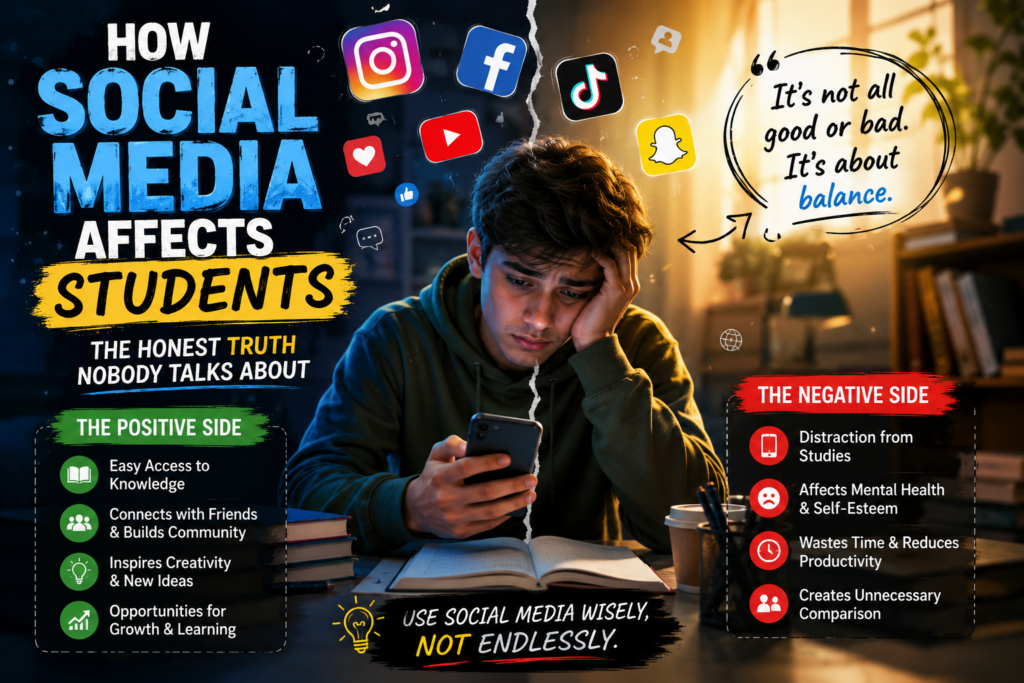
Let me draw you a scene. It’s like 11 PM. You’ve got a test tomorrow morning. Your notes are sitting there in front of you, neat and quiet. And still somehow… without even catching it as it happens, you’re 47 weeks deep in someone’s Instagram scroll.
Sound familiar? Yeah. I thought so.
Every student I know has been there. That moment where you meant to check one notification, and suddenly, an hour has vanished. Understanding how social media affects students goes way beyond the usual “just put your phone down” advice — it doesn’t just sit around stealing minutes. It affects us in ways that go much deeper than time wasting.
In this post, I want to talk honestly about both sides — the good and the bad — because it is not as simple as “social media is bad, put your phone down.” It’s more like, complicated, and kind of sneaky in how it shows up.
First — Let’s Be Real About How Much We Use It
Studies show that the average student ends up spending anywhere between 3 to 6 hours on social media every single day. Which is basically more time than most students spend studying, and more time than they spend exercising. Sometimes even more time than they spend sleeping — like, seriously. Platforms such as Instagram, YouTube, Snapchat, and TikTok are made to keep you scrolling. Every notification, every like, every new video is engineered to yank your attention back. It’s not really a willpower thing; it’s a design thing.
The Bad Side — And Yes, It Is Real
1. It Kills Focus and Study Time
This one hurts to admit, but it’s true. Social media is one of the biggest enemies of deep focus. The second your phone buzzes during a mid-study session, your brain just shifts attention — and research shows it takes about 23 minutes to really refocus after a distraction.
Now multiply that by the ten times a day you check your phone while studying. That’s hours of real concentration gone. Not because you’re lazy, but because your phone literally interrupted your thinking every single time.
“I used to think I was bad at studying. Then I turned off my notifications for a week. Turns out, I was just constantly distracted.”
2. It Messes With Your Mental Health
Scrolling through Instagram while you are having a rough week is one of the worst things you can do for yourself — and most of us do it anyway.
You see your classmates travelling, celebrating achievements, looking happy and put-together. And suddenly your ordinary Tuesday feels small and depressing. That feeling has a name — social comparison — and it quietly destroys self-confidence in students every single day.
The truth is, everyone is showing their highlights. Nobody posts their failed exams, their bad days, or the nights they cried out of stress. But when you only see the good parts of other people’s lives, it is easy to feel like you are falling behind — even when you are doing just fine.
3. It Disrupts Sleep
Raise your hand if you have ever told yourself “Just five more minutes” at midnight, and then looked up to find it is 2 AM. We have all been there. That blue light from screens suppresses melatonin, the hormone that helps you sleep. Late-night scrolling tricks your brain into thinking it is still daytime. So you end up sleeping in, waking up exhausted, and dragging yourself through class struggling to take anything in.
Poor sleep affects memory, concentration, mood, and even grades. And for a lot of students, the sleep problem starts, ends, and keeps lurking — with the phone sitting right there on the bedside table.
4. Cyberbullying Is a Real and Painful Problem
Not every student goes through it — but far too many do. Online bullying, harsh remarks, being left out of group chats, or having embarrassing material shared without permission can trigger very real emotional damage.
Unlike bullying that happens in a physical place, cyberbullying follows you home. It is right there on your phone at midnight. It does not quit when school ends. And since a lot of it happens quietly, students tend to endure it alone, without saying a word to anyone.
The Good Side — And There Genuinely Is One
5. It Connects You to Knowledge and Inspiration
Social media is not all bad — not even close. Some of the most valuable things I have learned as a student came from a YouTube video, a Twitter thread, or an Instagram carousel post that someone shared.
There are creators and educators on every platform breaking down complex topics in ways that are engaging and easy to grasp. Sometimes a 10-minute YouTube clip explains a concept better than a one-hour lecture ever could. Platforms like LinkedIn also help students:
- Discover internship and job opportunities early in their career
- Follow industry leaders and stay updated on their field
- Build a personal brand before they even graduate
- Connect with mentors who can guide their career path
6. It Builds Real Communities
If you have ever been in a study group on WhatsApp, a Discord server for your course, or a Facebook group for college, you already know how strong these communities can be.
Students drop notes, untangle doubts, push each other forward before exams, and share wins together. These digital spaces can be as meaningful as the ones people build inside classrooms — sometimes even more so.
For introverted students, or anyone studying far from home, online communities often become a real support system during some of the loneliest periods of student life.
7. It Lets You Show Who You Really Are and Keep Improving
Lots of students say they found their passion — writing, photography, design, comedy, cooking — because of social media. What started as a casual post slowly became a portfolio. A hobby turned into an actual opportunity.
Social media gives students a place to share their perspective, try out creative ideas, and get honest feedback from real people. That is not something a classroom task can fully replicate.
How to Find the Balance
The goal is not to quit social media altogether — that is unrealistic and honestly not necessary. The point is to use it with intention, not just out of habit.
A few things that actually helped me:
- Set screen time limits on the apps that eat the most time
- Keep your phone out of the bedroom at night — charge it in another room
- Turn off non-essential notifications during study hours
- Follow accounts that teach or lift you up, not only the ones that entertain
- Take one full day off from social media each week and notice how you feel
- Ask yourself honestly — “am I scrolling out of boredom, or genuine curiosity?”
Small shifts in how you use social media can make an oddly big difference to your focus, mood, and general wellbeing.
Final Thoughts
Once you really understand how social media affects students — the focus it drains, the sleep it disrupts, the confidence it quietly chips away, but also the communities it builds and the knowledge it unlocks — you stop seeing it as just an app. It is a tool. And like any tool, what matters most is who is in control of it.
You’re the one holding the phone. Make sure you’re the one choosing what happens next.